There is a familiar frustration among watch enthusiasts: you buy a new watch, admire its immaculate finish, and within weeks, the first scratches begin to appear. A mark on the clasp. A scuff on the case. Fine scratches that gradually change the appearance of a watch you intended to wear for years.
Stainless steel is durable, corrosion-resistant and exceptionally well suited to watchmaking. But conventional stainless steel is not particularly hard at its surface. Everyday contact with hard objects can leave scratches on the case and bracelet, gradually changing their appearance.
At Leitzeit, we believe good watchmaking means thinking beyond how a watch looks on the day you buy it. It also means considering how it will perform, feel and age over time.
That is why we use a specialised hardening treatment on both the case and bracelet of our watches, bringing the surface hardness to approximately 1,200 HV.
From 200 HV to 1,200 HV: A Harder Surface
The difference comes down to surface hardness.
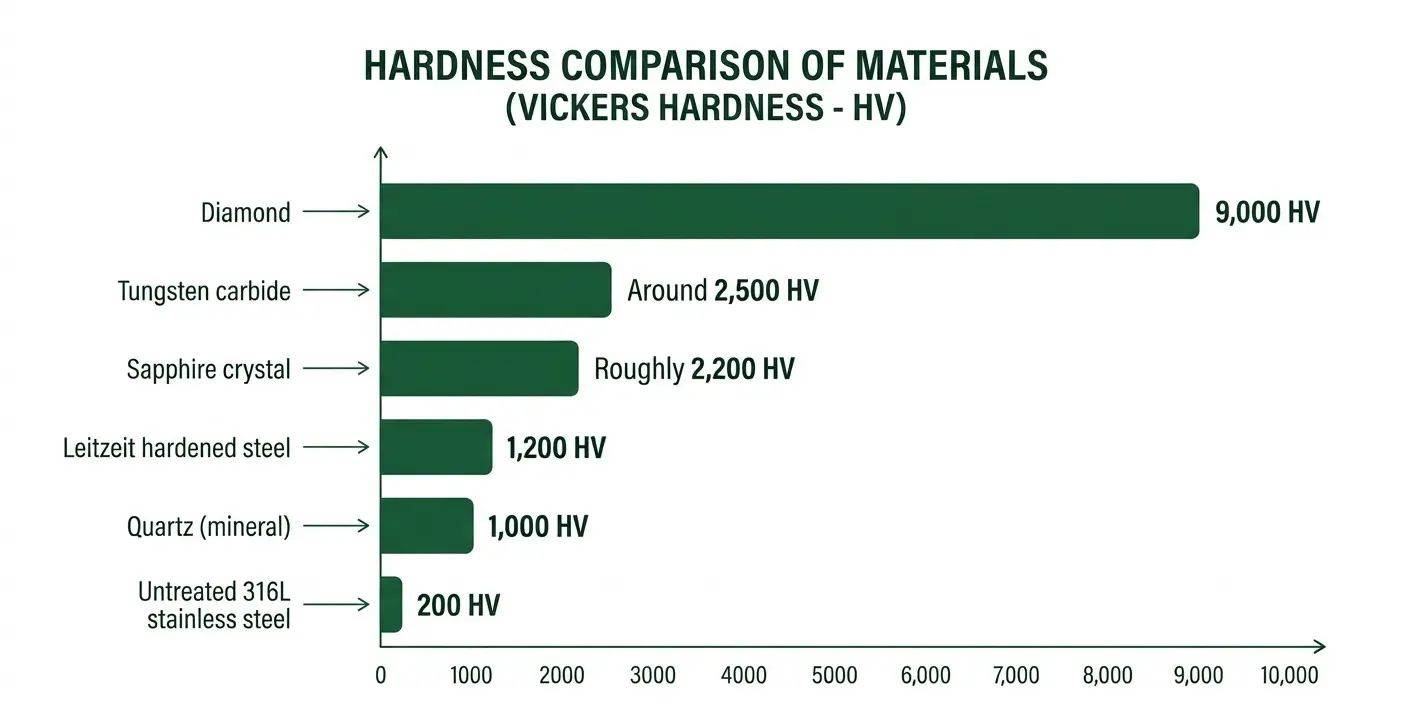
Conventional 316L stainless steel typically measures around 200 on the Vickers hardness scale (HV). Our hardened steel treatment raises the surface hardness to approximately 1,200 HV.
That is roughly six times the hardness of untreated stainless steel, measured on the same scale.
The Vickers hardness test measures a material's resistance to permanent indentation using a diamond indenter. While hardness is not a direct measure of scratch resistance in every situation, a substantially harder surface generally offers significantly better resistance to the scratches and scuffs that can accumulate during everyday wear.
For a watch, this distinction matters. The case and bracelet are constantly exposed to their surroundings: a desk edge, a door handle, another metal object or the countless small contacts that occur throughout the day.
A harder surface helps protect these components against the marks that ordinary stainless steel can pick up so easily.
The Same Protection for Case and Bracelet
The case and bracelet are two of the most exposed parts of a watch. Yet they often receive different levels of attention when it comes to long-term durability.
We take a different approach.
On our watches, the hardened steel treatment is applied to both the case and the bracelet. This means the components that define the watch's external appearance benefit from the same approach to surface durability.
The bracelet is particularly important. It comes into contact with desks, tabletops and other hard surfaces throughout the day. Its clasp and links can be especially susceptible to visible wear.
By treating the case and bracelet alike, we aim to preserve the appearance of the complete watch, rather than focusing on one component alone.
What Does 1,200 HV Actually Mean?
Numbers are useful, but only when they mean something.
HV stands for Vickers hardness, a standard measurement used to assess a material's resistance to indentation. During the test, a diamond-shaped indenter is pressed into the surface under a specified load. The resulting indentation is measured to determine the material's hardness.
A higher HV value indicates a harder surface.
Conventional 316L stainless steel typically measures around 200 HV, although actual values vary with the material's condition and processing. Our hardened steel reaches approximately 1,200 HV at the treated surface.
This does not mean that the entire steel component becomes six times stronger, nor does it mean that the watch is six times more scratch-resistant in every possible situation. Surface hardness and scratch resistance are related, but they are not interchangeable measurements.
What the specification does tell you is that the treated surface is substantially harder than conventional untreated stainless steel, offering a meaningful advantage in resisting everyday surface damage.
Is the Watch Scratch-Proof?
No. And we would not claim otherwise.
Even hardened steel can be scratched or damaged under sufficiently demanding conditions. Contact with harder materials, sharp edges or significant force can still leave a mark. The underlying steel also retains its own mechanical properties, regardless of the hardness of its treated surface.
The purpose of the treatment is not to promise an indestructible watch. It is to make the watch more resistant to the wear that comes with being used as intended.
We think that is a more meaningful goal.
A mechanical watch is a precision instrument, but it is also a personal possession. It travels with you, accompanies you through everyday routines and becomes part of your experiences. Its durability should reflect that purpose.
Built to Be Worn, Not Kept in a Box
At Leitzeit, we create independent automatic watches that bring together purposeful functionality, thoughtful engineering and distinctive design.
We believe a watch should be valued for what it is, not simply for the name on its dial. That means paying attention to the details that influence ownership over the long term, including those that may not be immediately apparent in a photograph.
Our hardened steel case and bracelet are one example. The treatment does not change the fundamental character of stainless steel or eliminate the possibility of scratches. Instead, it improves the surface hardness of the components you interact with every day.
It is a practical engineering decision, guided by a simple principle: a watch should be designed for real life, not just for the moment it is unboxed.
Because great watchmaking starts with substance, not status.
Leitzeit — Independent Automatic Watches. Built Without Compromise.