At first glance, a Worldtimer watch might appear complicated. You can see various names of cities, revolving rings, and a dial that is completely unlike that of a standard watch. It can even be confusing at first sight.
But once you understand it, everything becomes clear.
A worldtimer is not merely a time telling device. It is a timepiece, which tells you the time of the whole world—at the same time. It connects you to time across the world in a fascinating way.
More to the point, Worldtimers do not become popular with collectors because they are useful. They are their favorites because they are an embodiment of engineering, history, travel and artistry all in a single watch.
In this article, you will learn:
- What a Worldtimer is
- How it works
- Its history
- How it differs from GMT watches
- Why collectors love it
Let’s start simple.
What Is a Worldtimer Watch?
A worldtimer watch is a special kind of watch, which is capable of displaying the time of more than one time zone simultaneously. Rather than one place, it provides you with a worldwide perspective of time directly on your wrist.
The majority of worldtimers show time in 24 large cities and each of these cities is one of the principal time zones in the world. This system is based on global time zones, where the Earth is divided into 24 sections.
You do not have to take out your phone to check or even compute time differences in your head; you can just get a quick look at your watch and it will automatically tell you the following:
- What time is it in New York?
- What time is it in London?
- What is the time in Tokyo?
All at once.
This is what makes it unique and powerful.
A worldtimer provides you with a full global time picture as opposed to a regular watch that displays only one time or to a GMT watch, which will tend to display two or three time zones. It has the feeling that you are carrying the clock system in the world on your wrist.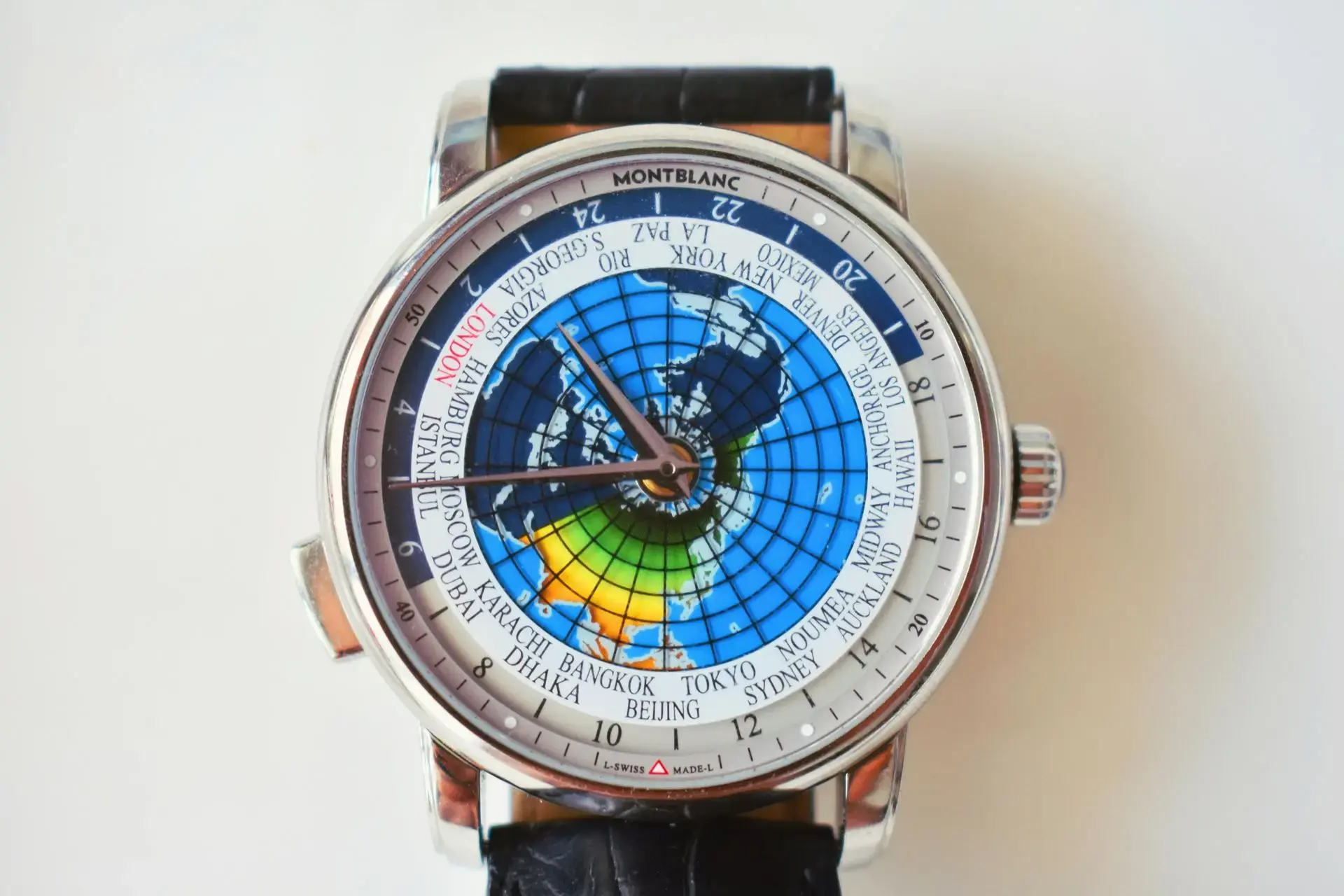
How Does a Worldtimer Work?
Now we shall divide it in a very simple manner.
A worldtimer is operated by a set of rotating discs and rings operating in a synchronized and specific system. These sections have been thoroughly designed in such a way that they remain accurately in line with actual time zones.
There are three principal components of most Worldtimers:
- A city ring
- A 24-hour disc
- A central time display
These sections collaborate to indicate time all over the world in a manner that is both mechanical and graphic. When properly adjusted, the watch will automatically keep track of the global time without any additional effort on your part.
Core Components of a World Timer
1. City Ring
The names of the major cities of the world (London, Paris, Tokyo, and New York) are depicted in this outer ring. Each city corresponds to a time zone. With the help of this ring, you can easily recognize various regions of the world.
2. 24-Hour Disc
This disc spins after every 24 hours and it is located in the city ring. It normally contains a light and dark part so that you are able to easily identify whether it is day or night in any city. This aspect gives them functionality and visualization.
3. Main Hands (Hour and Minute)
These hands indicate your local time just like any other watch. They serve as the point of reference of all the rest of the time zones on the dial.
How the Mechanism Displays 24 Time Zones
Here is the manner in which all this will fall into place in a very basic manner:
- You start with your local city (say Dubai or London) on the dial at the top.
- The 24 hour disc is rotated round the clock.
- The cities of the ring correspond to the hour on the 24-hour disc.
Due to this synchronized system, all the cities automatically display their appropriate time. Therefore, rather than manually set up the different time zones, the watch does it all. You have access to the world time without having to do any calculations.
At first glance, it may seem complicated, but once you become familiar with the design, it is very user-friendly. It's a little complicated, but once you get used to the dial, it's pretty straightforward.
How to Read a Worldtimer Watch (Real Example)
We can simplify it further with a simple example.
Suppose your watch indicates:
- London at the top
- There is a 24-hour disc that indicates 10 next to London.
That means:
- It is 10:00 in London
Now you look at Tokyo on the city ring. If it lines up with 18:
- It is 6:00 PM in Tokyo
You have not computed anything. You did not push any buttons.
You just read the time by the dial itself.
After a few attempts, you will be able to read a Worldtimer in a flash.
It is the charm of this complication—it makes a simple thing complicated.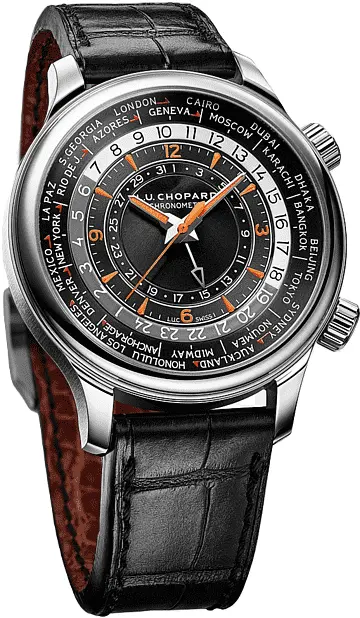
The History of the Worldtimer Complication
The reason collectors adore Worldtimers is that you must know the origin of Worldtimers. Watching the time of the world is not a new concept that began with watches. It began with the necessity of improved cross-country coordination.
Towards the end of the 19th century, a system of 24 time zones was adopted by the world, basing it upon the rotation and longitudes of the earth. This system enabled nations to use a standard time system, and this made the traveling of people, trade and communication across the nations easier.
For example:
- Schedules required precision on trains.
- Companies required coordinated working hours.
- There needed to be regular timing in communication systems.
Nevertheless, the watches of that period were capable of showing only one local time. It was not an easy way of looking at time around the world on your wrist.
That issue resulted in one of the most significant watchmaking inventions.
The Role of Louis Cottier
All that changed in the 1930s.
Louis Cottier, a very talented Swiss watchmaker, was the first to make the practical world timer. His design addressed the task of showing more than one time zone in an understandable and readable manner.
He proposed a system that employed the following:
- A 24 hour rotating disk.
- A ring of the city symbolizing time zones of the world.
This design enabled people to view the times of all major cities simultaneously, without having to change them individually.
Modern Worldtimer watches are based on his invention.
Most luxury Worldtimers remain to this day based on the same fundamental principle as that which Cottier invented. That demonstrates how mighty and eternal his innovation was.
Evolution in Luxury Watchmaking
Following the release of the Worldtimer, the Worldtimer was rapidly receiving attention within the realm of the luxury watchmaking industry after Cottier had invented it.
This complication started to be used in luxury brands due to the following reasons:
- It showed technical prowess.
- It had a distinct feature that was not available in ordinary watches.
- It attracted global tourists and businessmen.
As early as the 1940s, such brands as Patek Philippe popularized Worldtimers, launching very classy and highly sought-after models.
Over time:
- Designs were more sophisticated.
- Movements were more accurate.
- Dials were more decorative and elaborate.
The Worldtimer is one of the most admired and respected horological complications to this day. It is a perfect combination of functionality, history and craftsmanship, and that is why it is still highly treasured by the collectors.
Worldtimer vs GMT Watches: Key Differences Explained
Most individuals mistake Worldtimers with GMT watches.
They are alike in sound and both operate with multiple time zones, but they operate in very different ways.
This disparity is made evident when you realize how both of them tell time and what they are meant to be used to.
We shall simplify it down.
Let's keep it simple.
What Is a GMT Watch?
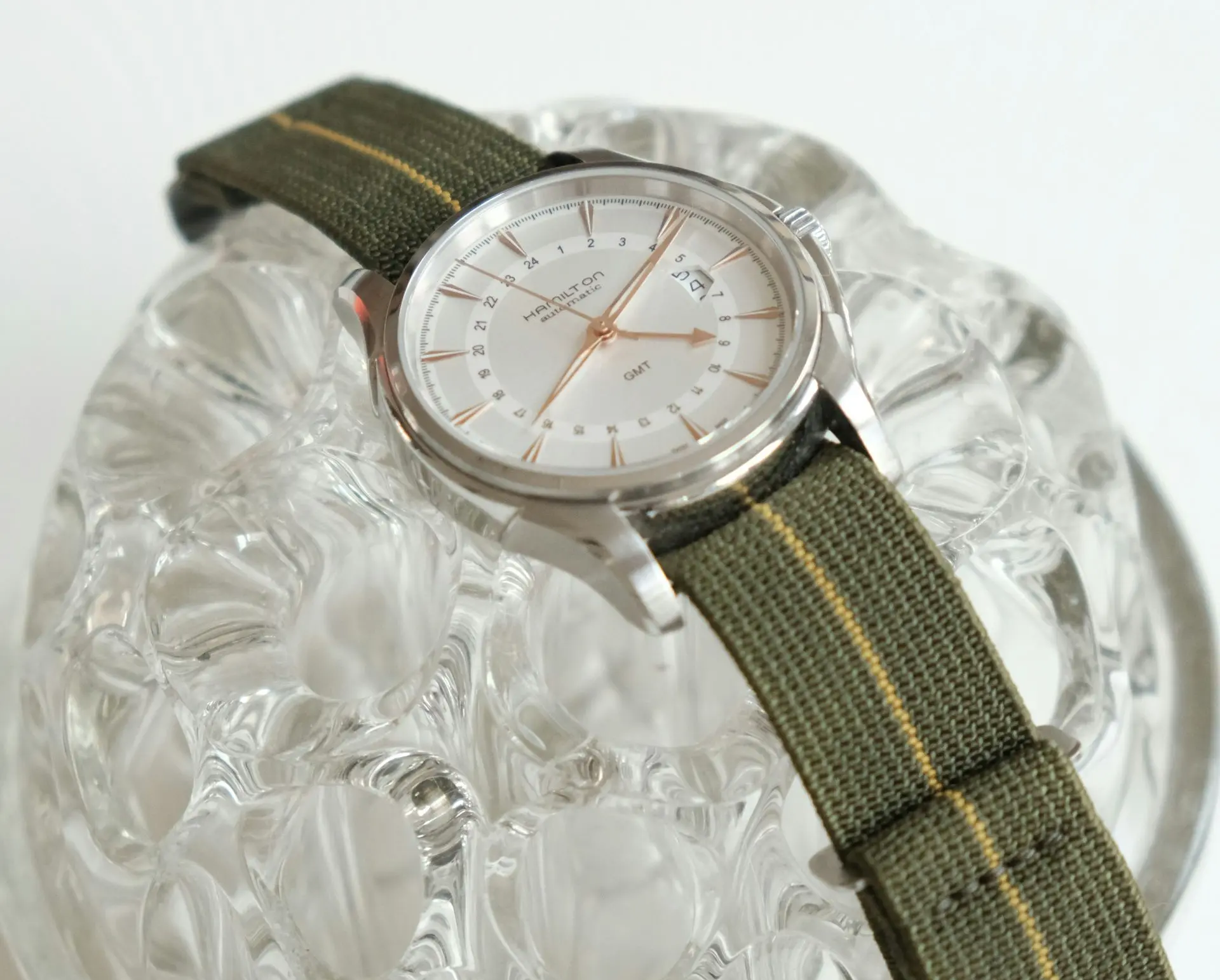
A GMT watch follows two (and in some cases, three) time zones.
It has an additional hour hand commonly referred to as a GMT hand, which points to a 24 hour scale on the dial or bezel. This will enable you to monitor time in a different place without altering your primary time.
Since a GMT watch has a built in GMT, you can easily keep track of
- What is your time of the day (where you are)
- Where you live or work (home time).
There are also more sophisticated GMT watches that enable you to keep time in a third time zone by rotating the bezel.
This renders GMT watches:
- Easy to use
- Quick to adjust
- Most convenient to the travelers
Worldtimer vs GMT: Side-by-Side Difference
The main differences are as follows:
Feature | Worldtimer | GMT Watch |
Time Zones | Shows 24 at once | Shows 2–3 |
Display | City ring + 24-hour disc | Extra hour hand |
Complexity | High (advanced mechanism) | Moderate (simpler system) |
Use | Global overview | Travel convenience |
A Worldtimer provides you with the picture of the whole world's time in a single look.
The GMT watch is all about simplicity and keeping time in only one other time zone.
And thus they are both useful, but each has its use.
Which One Should You Choose?
It will be determined by your intended use of the watch.
- A GMT watch is a superior choice in case you are interested in something plain and convenient to use during traveling.
- A Worldtimer is the proper watch to have in case you desire a watch that indicates world time in a gorgeous and mechanical manner.
Worldtimers are practically never left out by collectors, as they are not merely functional but full of depth, style and complexity.
Why Worldtimer Watches Are a Collector’s Favorite Complication
Here we come to the most significant section.
What is so attractive to collectors about Worldtimers?
The solution is more than practical. It is reduced to craftsmanship, meaning the experience of possessing something special.
Mechanical Mastery
A Worldtimer is not a simple thing to make.
It requires:
- Absolute alignment of moving components.
- Advanced engineering design
- Very high levels of mechanical motion.
All of its components have to remain correlated to the real-world time zones. Accuracy can be compromised by even a minor mistake.
Watchmakers take years to perfect such mechanisms. Such effort and expertise render Worldtimers very revered in the watch industry.
To collectors, this complication is not an issue—it is the primary attraction.
Artistic and Visual Appeal
Worldtimers are distinguished at first glance.
They often include:
- Dial has detailed world maps.
- City names engraved carefully.
- Three dimensional designs and textures.
There are even models with miniature globes or hand painted continents in the center of some high end models.
Due to this fact, a Worldtimer is not just a watch; it is a part of wearable art. It gets attention in a manner that ordinary watches cannot.
Rarity and Prestige
All watches brands do not produce Worldtimers.
They require:
- Skilled craftsmanship
- Additional time to produce.
- Specialized design knowledge
This renders them less prevalent than regular watches.
Due to their limited number of productions, Worldtimers tend to have increased value and prestige. These watches are even better as collectors tend to seek rare and unique items.
Historical Importance
Worldtimers will put you in touch with world time history.
They represent:
- The emergence of international traveling.
- The necessity of synchronized world time.
- The invention of mechanical watchmaking.
Wearing a Worldtimer, you are not wearing a modern device only but also a concept that revolutionized the way people comprehend time on the planet.
Emotional Value Beyond Practicality
Herein is a curious thing.
The vast majority of the collectors do not even require a Worldtimer.
Their phones are already able to display the time in the world in real time.
Yet they do desire one.
Why?
Since a Worldtimer is a symbol of
- A global mindset
- An interest in traveling and exploration.
- A strong love of art.
It turns into a personal statement. It demonstrates that you are not only interested in functionality but also design, history and meaning.
This is what makes a Worldtimer special.
Iconic Worldtimer Watches Loved by Collectors
The design, history and craftsmanship of some of the Worldtimers have made them legendary in the watch world.
- Patek Philippe World Time: The classic design and high demand of collectors.
- Vacheron Constantin Overseas World Time: Known to be luxurious in its finishing and artistry on its dial.
- Jaeger LeCoultre Geophysic Universal Time: Admired due to technical perfection and innovation.
These watches demonstrate how leading brands have been able to integrate engineering expertise with artistic elegance in producing watches that are deeply appreciated by collectors.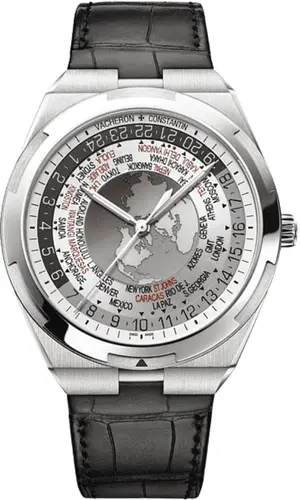
An Accessible Modern Worldtimer
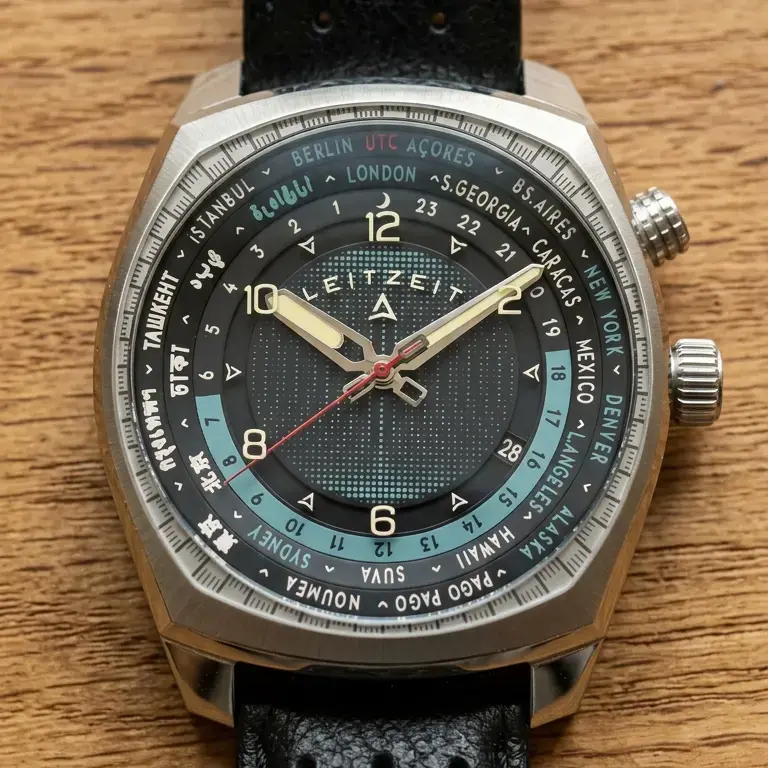
While many worldtimer watches from established Swiss brands are positioned in the luxury segment, independent brands are making this celebrated complication more accessible to a wider audience.
One example is the Leitzeit Axis Mundi, a modern worldtimer powered by the Miyota 9075 true GMT movement. Unlike a conventional GMT watch that primarily tracks a second time zone, the Axis Mundi combines a true GMT movement with a worldtimer display, allowing the wearer to reference all 24 global time zones at a glance.
Designed for everyday travel, the Axis Mundi features:
- Miyota 9075 automatic true GMT movement
- Worldtimer display with 24 global time zones
- Scratch-resistant sapphire crystal
- 316L stainless steel case
- Exhibition caseback
- 100 m water resistance for everyday wear
Designed for enthusiasts who appreciate thoughtful engineering rather than prestige alone, the Axis Mundi demonstrates that a mechanical worldtimer can be both attainable and rewarding without compromising on quality or functionality.
Advantages and Limitations of Worldtimer Watches
Advantages
- Displays time zones in real time without calculation.
- Has a distinctive and attractive style.
- Has great worth to collectors and enthusiasts.
Limitations
- May seem complicated initially.
- More likely to be costly than regular watches.
- And it is not the fastest all the time to check the time.
Knowing both sides will assist you in determining whether it suits your lifestyle.
Are Worldtimer Watches Practical or Collectible?
Let’s be honest.
In seconds your smartphone can display world time.
But do you need a world timer?
Not really.
But that is no point.
A Worldtimer is more about
- Passion for watches
- Appreciation of mechanical artistry
- Fancy design and detail.
It is workable—but its true worth is in the experience that it gives.
How to Choose the Right Worldtimer Watch
When you are going to purchase one, pay attention to the following factors:
- Brand Reputation: Select the brands that have high quality and reliability.
- Quality of Movement: A quality movement guarantees longevity of performance.
- Readability of the Design: Ensure that you can read the dial easily.
- Price: Worldtimers are available at a large price scale.
Above all, get a watch that you like to wear and check every day.
Care, Maintenance, and Longevity
Timers of the world need appropriate care due to their complicated motions.
To maintain your watch in good condition:
- Have it serviced after every few years.
- Beware of powerful shocks or falls.
- Store safely and keep clean.
A well-maintained Worldtimer will last decades and even become a family heirloom.
The Future of Worldtimer Watches
Worldtimers continue to be valued, even in the wake of smartwatches.
Why?
Due to the fact that luxury watches are no longer a tool. They are:
- Collectibles
- Long-term investments
- Individual manifestations of style.
Worldtimers are the finest of old school watches. They are a mixture of both functionality and emotion and this is what makes them relevant even in a digital world.
Conclusion: Why the Worldtimer Remains a Timeless Collector’s Piece
A Worldtimer watch is not just a time telling device. It is an all-encompassing system that links you to a whole world. It incorporates history, engineering and design in a manner that few watch complications can match. Having known the working of it, you begin to appreciate the reason why collectors love it so much.
We think that a great watch is more than a timepiece, at Leitzeit, it is a watch that represents your style, your adventure, and your love of the art. This is why we concentrate on the timepieces that are both innovative and classic. Whether you are willing to go beyond the usual, We invite you to visit our collection and select a watch that best reflects who you are.
Top 5 Trending FAQs About Worldtimer Watches
1. What does a Worldtimer watch do?
A Worldtimer is a type of watch that indicates the time in several cities around the globe simultaneously, generally covering all 24 standard time zones.
2. Is a Worldtimer better than a GMT watch?
It is based on your needs. A Worldtimer displays all time zones simultaneously, whereas a GMT will be dedicated to one or two more zones. Worldtimers are more complex and collector-friendly.
3. Are Worldtimer watches hard to use?
Initially, they might appear to be complicated. However, as soon as you have the city ring and 24-hour disc, there is no difficulty in reading and it takes a short time.
4. Why are Worldtimer watches expensive?
Their cost and value are enhanced by their need for sophisticated engineering, accuracy in movement, and finesse in craftsmanship.
5. Do people still use Worldtimer watches today?
Yes, watch fans and collectors, in particular. They are more appreciated by people due to craftsmanship, design, and history rather than their day-to-day convenience.