The Astronaut Watch narrates the tale of accuracy, bravery, and man in space. It has made a journey through the void of space, withstood extreme temperatures and conditions and has been used to time the greatest missions in the history of the world, and it proves that timekeeping in space is as daring as the spacemen themselves.
The History of the Astronaut Watch
Whenever you consider space exploration, rockets and astronauts come to mind. However, there was also a little and quiet hero that also wrote history: the Astronaut Watch. This timepiece was special since it assisted the astronauts to determine time when seconds were life.
- Protest against the cosmos: It shows our desire to make technology transcend beyond the boundaries of the earth.
- Accurate in the stressed situation: These watches were accurate within launch vibrations, exposure to vacuum, and life threatening missions.
- More than a watch: Every Astronaut Watch was a reliable companion in terms of navigation and monitoring of oxygen and time of missions.
- Designed to be great: The concept of greatness is captured in the durable design and mechanical precision that is the same kind of innovation that underlies space exploration.
Since the early missions, this watch will make you remember that being able to travel past the stars all depends on precision, durability and courage.
What Is an Astronaut Watch?
Astronaut Watch is not any ordinary wristwatch; this watch is created to work in the extreme conditions where the behavior of gravity, air, and temperature are different.
Special to a real Astronaut Watch is the following:
- Massive endurance: Has to withstand the vibrations and the G-forces during launch.
- Precision in stress: Is ideal in low gravity and heavy radiation places.
- Temperature resistance: Has a range of -150 deg C to +120 deg C.
- Pressure resistant construction: Seals and crystals remain firm to the expansion of the vacuum.
- Vivid testing: All components, including the case and crystals undergo vacuum chambers and thermal testing.
It is not a fashion thing; it is a work thing. Astronauts depend on such watches as lifelines when they are lying on the ground and there is no room to make mistakes.
The First Watches in Space: How It All Began
The Astronaut Watch has a story that started with courage and creativity in the earliest space missions in the 1960s.
Yuri Gagarin’s historic flight (1961)
The first human to travel to space was Gagarin who used the Sturmanskie wristwatch. It was not a spacecraft, but it was ideally suited there. Its hand-wound clock did not rely on gravity and this showed that mechanical precision was capable of coping with new frontiers.
NASA’s watch testing program
With space missions picking up, NASA desired a timepiece that would be reliable to an astronaut regardless of the situation. They put watches of leading brands to test them by exposing them to:
- Vehicle simulated launches cause intense vibrations.
- Unpredictable shocks and acceleration.
- Swings in vacuum and high temperatures.
Omega Speedmaster comes out winning
There was a trial after trial and at the end of several months only one watch scored in all the tests—the omega speedmaster. It was absolutely accurate when others pulled out, broke down or wasted time.
It was the start of the Astronaut Watch era, where timekeeping was now an essential survival tool and not an accessory. All missions that followed had a watch that was made to reach the stars.
The Omega Speedmaster: The Iconic Astronaut Watch
Perhaps the most glorified Astronaut Watch of all time is the Omega Speedmaster Professional, also known as the Moonwatch. The trip of the Earth to the Moon made it the symbol of human success.
Official NASA approval:
Following cruel trials, the Speedmaster was to be the official Astronaut Watch of all manned space flights. It accompanied astronauts in the Gemini, Apollo and Skylab missions.
Why it was perfect for space:
It had the manual-wind chronograph movement, which is best suited to the zero-gravity conditions because the automatic features rely on the movement of the wrist and the influence of gravity.
Its case and crystal were able to withstand extreme temperatures, cold and even vacuum with no harm.
It provided timing to the second which was important in burns, maneuvers and docking.
The Moon landing moment:
Buzz Aldrin used his Speedmaster to get onto the moon on July 20, 1969. One move made the watch a legend.
Apollo 13's rescue story:
Apollo 13 was crippled by an explosion, and 14-second long engine burns were also timed by astronauts with the help of the Speedmaster and rescued them. In its absence, it could not have been possible to go home.
The Omega Speedmaster is to this day NASA certified and continues to excite the watch enthusiasts and the adventurers as well. It is not an ordinary watch; it is the living evidence of how accuracy can save lives off of our planet.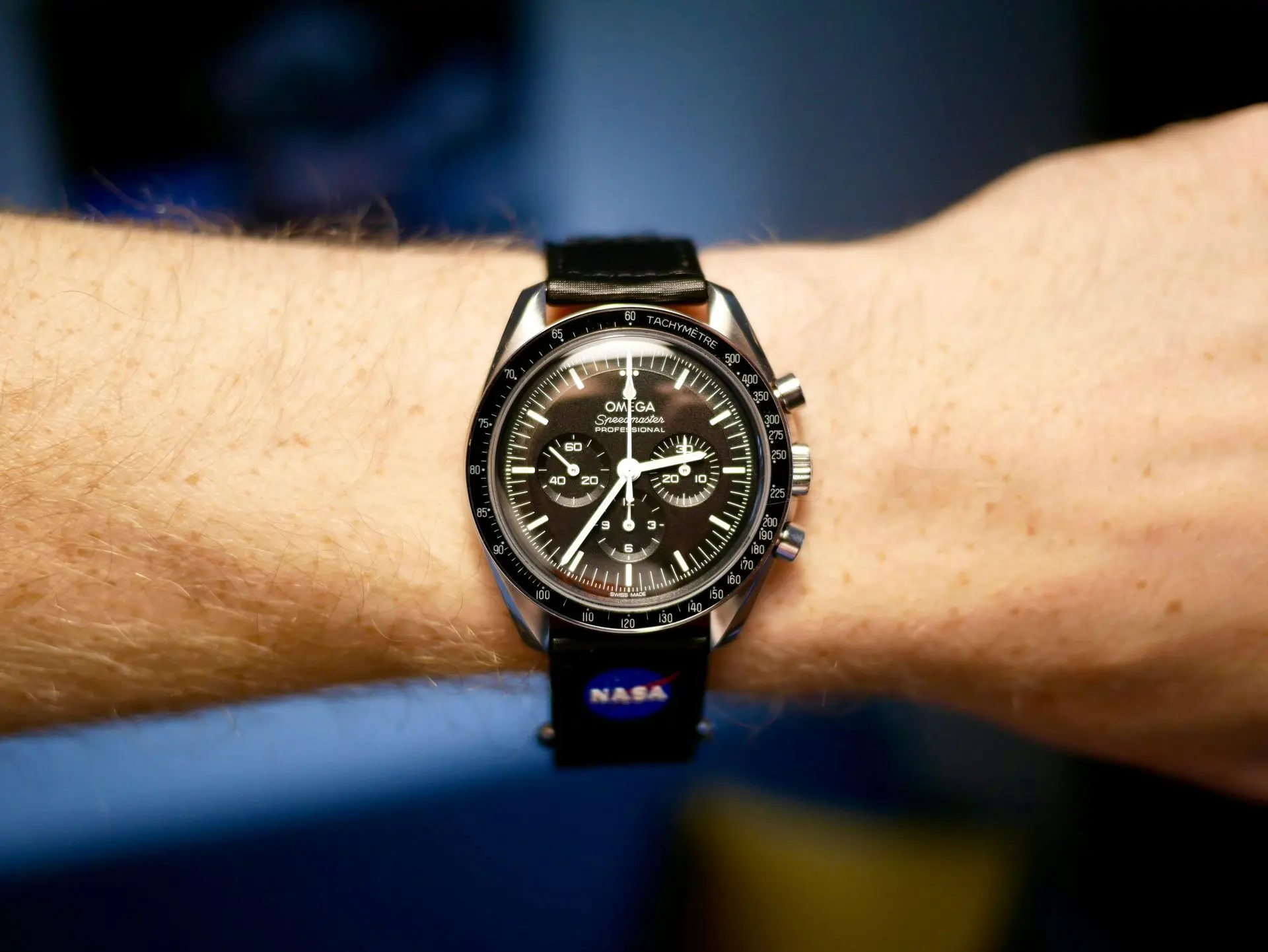
Automatic Watches in Orbit: Overcoming Zero-Gravity Challenges
Motion provides power to automatic watches. There is a little rotor inside and as you move, the mainspring is wound up. But engineers used to ask themselves a question-- was a zero gravity automatic Astronaut Watch possible?
Here's what they discovered:
The issue of microgravity:
Up and down are not visible in space. The rotor in the watch does not drop naturally; that is, it may not spin. Automatic watches would eventually stop without motion.
Testing new designs:
To address this, the Seiko and Fortis brands repackaged their mechanisms. They employed much better rotor weights and balance systems which were free to move in all directions including when floating.
Proven results in space:
The Fortis B-42 Professional Cosmonaut Chronograph was put to the test in several Russian Soyuz missions. Even with microgravity astronauts verified that it kept time perfectly.
The Spring Drive Spacewalk by Seiko operated on a hybrid movement that utilizes kinetic energy to generate electrical energy, which is then used to provide a smooth and precise performance during the missions to the ISS.
What this means for you:
These inventions demonstrated that the automatic watch can be run in times of floating as well as human movement. It was also discovered that mechanical engineering could well fit the strangest situations possible—redefining our notions of timekeeping.
This achievement was a new beginning for the Astronaut Watch because it showed that automatic watches do not merely survive in space but they flourish there.
Other Legendary Space Watches
The Omega Speedmaster became a legend, but it was not the only one in the history of space. A number of other watches had a place among the stars.
Bulova Lunar Pilot Chronograph
This watch was with Apollo 15 in the year 1971. Upon the breakdown of Commander David Scott's Omega, he had put on his own prototype Bulova. It was flawless in the moonwalk and it later became the treasure of a collector.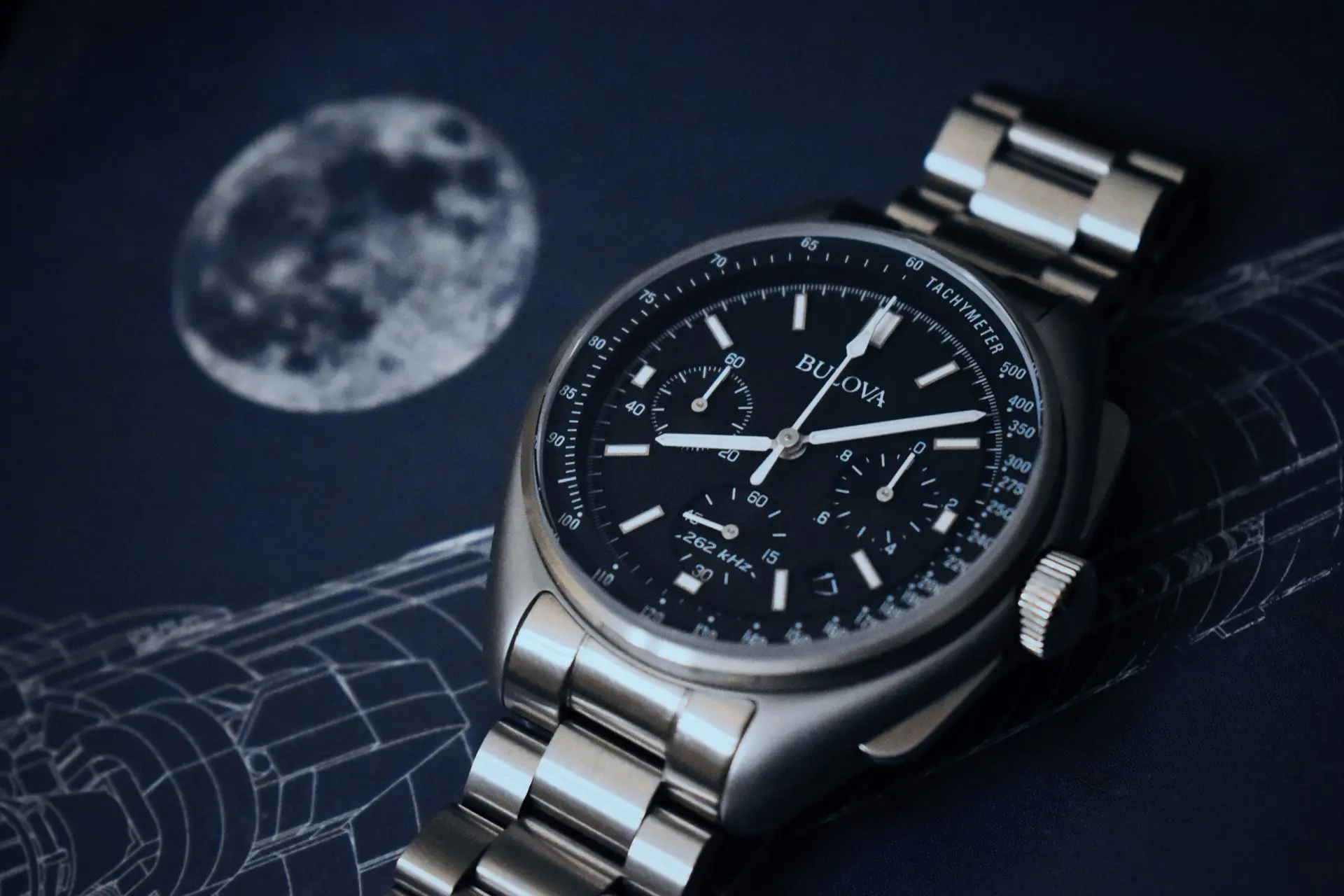
Fortis B-42 Official Cosmonaut Chronograph
This was to become the official Astronaut Watch of Russian cosmonauts in the 1990s. It was constructed on an automatic movement and was used on several missions in the International Space Station (ISS).
Seiko Spring Drive Spacewalk
Japanese astronaut Richard Garriott wore the Seiko Spring Drive Spacewalk in 2008 on his trip to the ISS. It incorporated the traditional craftsmanship with modern technology; it had ultra-smooth movement and space tested precision.
All these models are a stepping stone in horological innovation. They demonstrate how the brands exceeded themselves to satisfy the needs of space traveling.
How Modern Astronaut Watches Are Designed for Space Missions
The current Astronaut Watches are the masterpieces of the engineering world, and they are capable of withstanding all the forces of space.
Materials Used:
- Titanium: corrosion free and light.
- Sapphire crystal: it does not scratch and break easily.
- Ceramic and carbon fiber are both stable under pressure and radiation.
Testing Process:
- Put in open air under vacuum chambers and thermal cycles.
- Vibrated on simulation launchers.
- Re-examined following all endurance tests.
Modern Innovations:
- Movements to minimize maintenance, which are solar powered.
- Mission-timing Hybrid analog-digital display.
- Precision time zone GPS synchronization.
With these attributes, the contemporary Astronaut Watch is as reliable in space as it is in the atmosphere.
Astronaut Watch Collectors and Legacy on Earth
On Earth, the Astronaut Watch is a dream to the collectors. It is not only about timekeeping but also about having a part of history.
Why collectors love them:
- Close association with space missions of the past, such as Apollo 11.
- Classic style and quality that can never be out of fashion.
- Sensual attachment to human heroism and exploration.
Popular Collector Models:
- Omega Speedmaster Moonwatch.
- Bulova Lunar Pilot Reissue.
- Fortis Cosmonaut Chronograph.
It is like having a story of human adventure on your wrist it is like owning a story of human exploration and every day you put it on, you remember that precision and courage are inseparable.
The Future of Astronaut Watches: Space Tourism and Beyond
With space tourism coming into reality, this watch is developing into a new generation.
The Future Outlook:
- The flights of SpaceX and Blue Origin provide a fresh market of space-ready watches.
- Omega, Fortis, and Seiko are already experimenting with next generation designs.
What's Next:
- Biosensor astronaut health monitoring.
- Longer missions require Radiation monitors.
- Sophisticated hybrid designs with traditional mechanics and digital technologies.
The Astronaut Watch you will have in the future may not merely tell time but it may also be your personal companion on a mission into space.
Challenges Faced by Watches in Space
Timepieces in space are subjected to circumstances that no timepiece on the planet would be able to manage without special construction. The temperature may vary between +120°C in the sunlight and -150°C in the shade. Radiation, vibration and zero gravity are also there.
Lubrication is one of the most difficult problems. Oils used in watches that are traditional may evaporate or freeze in space. That is the reason why Astronaut Watches are lubricated using space-rated lubricants that are stable in a vacuum and at very high temperatures.
The seals are also tested by having pressure differences. All gaskets and crystals should be tight in the case of expansion and contraction. Condensation would ruin the mechanism in the absence of an ideal sealing.
These difficulties led to decades of creativity. The very fact that every Astronaut Watch that reached space is evidence of careful work and human resources.
Why You Should Care About the Astronaut Watch
Although you might never visit space, this watch can still have some lessons that can be applied here on earth.
- There is no match to its durability: These watches are space-worthy—therefore, able to cope with your day-to-day adventures.
- Everyday accuracy: It doesn't matter whether you are tracking a workout or a meeting; it will be accurate.
- Ambition marker: Wearing one will remind you to keep dreaming big and being focused.
- Classic tradition: Every design incorporates performance, tradition and beauty.
The possession of the Astronaut Watch is not only a symbol of prestige but also a reminder of what mankind can accomplish when we look up.
Conclusion
The Astronaut Watch has become an icon that will never become outdated. Starting with the Gagarin of Sturmanskie to the Omega Speedmaster and the modern automatic watches, every watch has got its story of accuracy and boldness.
We honor the spirit of space bound watches at Leitzeit that make people strive to achieve more and dream more. It is our passion to link you to the workmanship that is found in each watch. Find your own watch and make your adventures not only to the stars but also to the planets.
FAQs
Why is a watch an Astronaut Watch?
This watch is designed to be able to cope with the harsh environment of space, including high radiation levels, microgravity, temperature changes, etc. It has to be precise and strong in launches and space walks as well as in reentry.
Which Astronaut Watch had been to the Moon?
The Omega speedmaster professional was the NASA certified astronaut watch that was taken to the moon with the astronauts on board on the Apollo 11 mission in 1969. It was worn even by Buzz Aldrin in his moonwalk.
Can automatic watches work in zero gravity?
Yes, there are automatic watches that are able to work in microgravity. Even in the absence of gravity their rotors follow the movements of the arms of the astronaut. This was demonstrated by the Fortis B-42 when conducting its missions in the ISS.
Why did NASA choose the Omega Speedmaster?
NASA also tested a number of watches and discovered that the Speedmaster was able to withstand all the conditions in terms of vibrations, shock and even vacuum tests. It was also the ideal Astronaut Watch because it was true when other watches proved to be wrong.
Are Astronaut Watches available for the public?
Yes, there are many of those space mission-based models that you can purchase. The most popular are the Omega Speedmaster Moonwatch, the Bulova Lunar Pilot, and the Fortis Cosmonaut Chronograph.